
Why Patrol Cars Cannot Cover Every Street
Illegal parking rarely happens where an officer is standing. Cars block crossings, stop in no-stopping zones and sit in front of hydrants in the gaps between patrol rounds, and a patrol car or an officer on foot can only be in one place at a time. The result is uneven enforcement: a few streets get ticketed often, most get ticketed rarely, and drivers learn which is which.
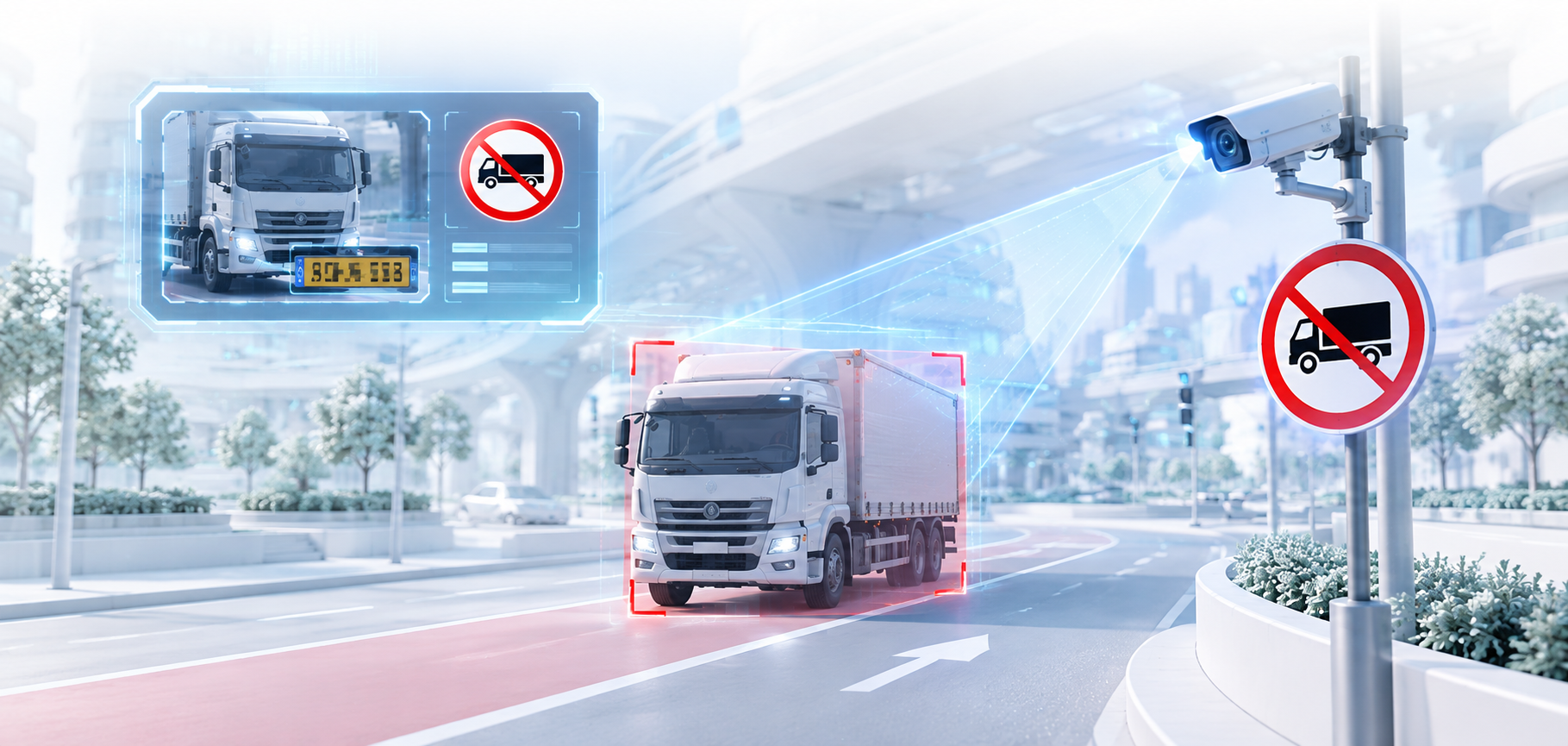
Smart enforcement cameras change the coverage problem. An AI-powered camera with Video Analytics Capabilities watches its zone continuously, recognizes a parked or stopped vehicle, checks it against the rule that applies at that spot and time, and records the violation without anyone needing to be nearby (Employing a blurring mechanism for the captured area to minimize privacy infringement—all in compliance with local regulations). The officer’s time moves from walking the street to reviewing evidence.
How Automatic Parking Violation Detection Works
Mview Analytics builds its enforcement platforms around Video Analytics & AI platform for object and event detection, combined with advanced video cameras (hardware and software) and IoT-based sensing. For parking, the detection flow has four parts:
-
Recognition: the camera identifies the vehicle, its position and how long it has been stationary.
-
Rule matching: the system compares what it sees with the restriction at that location, such as a no-stopping zone, a blocked crossing or a time-limited bay.
-
Evidence capture: footage and stills are recorded with the time and place, so the case does not depend on anyone’s memory.
-
Handover: the evidence is stored in an encrypted evidence management system and passed to the authority that issues the notice.
A human reviewer can check each case before anything is issued. That step matters for accuracy, and we cover it in the concerns section below (The data collected does not include identifying details, thereby preserving the privacy of passersby in accordance with the privacy policies and legal requirements of each country) .
Fixed Cameras Compared with Mobile Enforcement
Cities usually need both, because the two answer different problems.
Fixed cameras suit known trouble spots: a crossing that is blocked every afternoon, a bus stop approach, a street with a permanent no-stopping rule. They run all day, produce consistent evidence from a stable angle, and their presence alone often changes driver behavior at that location.
Mobile enforcement units suit the rest of the map. A vehicle-mounted system can cover many streets in one shift, follow complaints as they shift from one neighborhood to another, and reach areas where a fixed installation is not justified. The trade-off is that mobile coverage is periodic, not constant.
A practical approach is to put fixed cameras at the worst recurring locations and use mobile units to sweep everything else and to find the next hotspot. For cities starting out, a small pilot at a few locations shows which mix fits. Our guide on planning a smart traffic enforcement pilot project walks through site selection, baselines and KPIs.
Evidence Capture and Handover to the Authority
A parking fine only holds if the evidence does. Good platforms record what a reviewer or a court would need: the vehicle, the location, the time, and enough footage to show the vehicle was stopped where the rule forbids it. Data moves through integration into an encrypted evidence management system.
Integration deserves attention before purchase. The camera is only one part of the chain; the evidence still has to reach the municipal or police system that issues the notice. We go into this in our guide to choosing the right enforcement system, and into protecting footage and data in our article on cybersecurity in smart traffic enforcement.
Addressing Accuracy, Privacy and Public Acceptance
Accuracy. No detection system should be trusted blindly. The safeguard is a review step: the Video analytics capabilities combined with AI flags a candidate violation, and a person confirms it from the recorded evidence before a notice goes out. Starting with a pilot lets the city measure false positives against its own streets before expanding.
Privacy. Cameras on public streets raise legitimate data protection questions. Municipalities should settle the legal basis for recording, how long footage is kept, and who can access it. Encrypted storage and access controls are part of the answer, but the retention and use rules belong in the city’s own policy and in the applicable regulation MVIEW is proud to incorporate privacy protection and security mechanisms as an integral part of its systems, and possesses the capability to adapt the system to comply with any type of local regulation).
Public acceptance. Residents accept enforcement more readily when the purpose is clear. Cars parked across crossings and in no-stopping zones put pedestrians, buses and emergency access at risk, and explaining that, with signage where cameras operate, builds trust. The same logic applies to other lanes of enforcement, as in our pieces on pedestrian crossing enforcement and bus lane enforcement.