Why trucks on restricted roads are hard to police by hand
Most cities have streets, bridges and city-centre zones that heavy vehicles are not allowed to use. The signs are easy to put up. Enforcement is the hard part, because an officer cannot stand at every weight-limited bridge or residential street all day, and a truck that cuts through at night is gone before anyone writes it up.
AI cameras close that gap. They watch the restricted point continuously, recognize what type of vehicle is entering, check it against the rule that applies at that moment, and capture the evidence needed for a fine. This guide explains how that works and what a municipality should settle before it installs anything.
How AI cameras tell a truck from a car
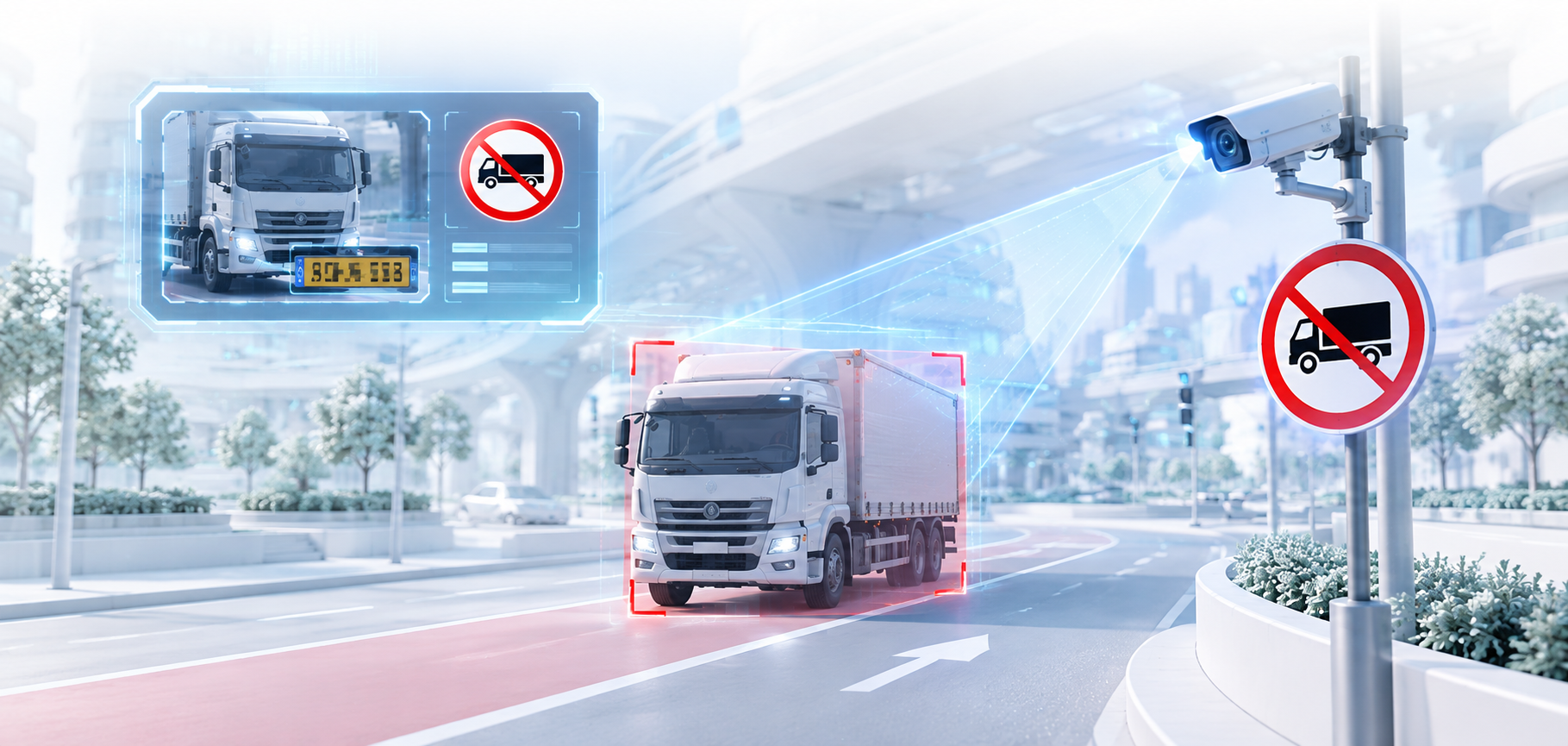
The core of the system is vehicle classification. Advanced video cameras feed an AI platform for object and event detection, which decides what each vehicle is: a passenger car, a van, a rigid truck, an articulated truck, a bus. The restriction then applies only to the classes the municipality has defined.
This matters because most restricted roads do not ban every large vehicle. A delivery van may be allowed where a semi-trailer is not, and a bus may be exempt. The classification rules have to match the legal text of the restriction, not a vague idea of what counts as heavy. Agree the exact categories with your legal team before configuration, so every detection maps to a defined violation.
Classification also needs to hold up in poor conditions: night, rain, glare and dense traffic. Test the camera angle and lighting at the actual site, not only in a demo.
Handling time-of-day and zone rules
Many truck restrictions are not absolute. A city-centre zone might close to heavy vehicles during the day but allow deliveries in the early morning. A bridge might be closed to one class and open to another. The enforcement system needs to apply the rule that is in force at the moment of detection.
- Set restriction schedules per camera or per zone, so the same vehicle is a violation at one hour and legal at another.
- Define exemptions up front, such as permitted routes, emergency vehicles or registered delivery windows, and decide how the system will recognize them.
- Record the active rule alongside each detection, so a reviewer can see why the event was flagged.
Keeping rules in the system, rather than in an officer’s head, is what makes enforcement consistent from one street to the next.
Capturing evidence that supports a fine
A detection is only useful if it can become a fine that survives a challenge. For each event, the system should capture the vehicle image, the plate, the location, and the date and time, tied to the rule that applied. Evidence is then stored in an evidence management platform with secure, encrypted handling so the record cannot be altered between capture and review.
A human review step before a fine is issued is good practice. It catches misclassifications and gives the municipality a documented decision for each case. Whether that review is required, and what a fine needs to contain, depends on local law, so confirm the requirements with your legal and police stakeholders early (In any case, the entire potential enforcement process for vehicles of this type requires a local regulatory review before a project is undertaken). Security of the camera network itself is part of evidence integrity; see our article on cybersecurity in smart traffic enforcement.
What to plan before deployment
The technology is the smaller part of the project. Most problems come from decisions made too late.
- Site selection: choose the entry points that actually matter, and check mounting, power, connectivity and sightlines at each.
- Legal basis: confirm the restriction is properly signed and enforceable by camera, and that police or the relevant authority has signed off on the process.
- Baselines and KPIs: count restricted-vehicle entries before you start, so you can show a change afterwards.
- Integration: the cameras should connect to your existing back office, not create a parallel system. Integration is the criterion procurement most often underweights, as covered in our guide to choosing the right enforcement system.
Starting with one or two locations is usually safer than a citywide rollout. Our walkthrough of a six-step smart traffic enforcement pilot covers site choice, KPIs and how to decide on scaling. The same camera and evidence approach is used for other restricted-access rules, such as bus lane enforcement.
To see how this fits your streets and bridges, you can review our enforcement solutions or request a live demo.
Frequently asked questions
How do AI cameras identify a truck?
Advanced video cameras feed an AI platform for object and event detection, which classifies each vehicle by type, such as car, van, rigid truck or articulated truck. The restriction is then applied only to the classes the municipality has defined.
Can the system handle restrictions that only apply at certain times?
Yes. Restriction schedules can be set per camera or zone, so the same vehicle is a violation during restricted hours and legal outside them. The active rule should be recorded with each detection so reviewers can see why it was flagged.
What evidence is captured for a fine?
Each event should include the vehicle image, plate, location, and date and time, linked to the rule in force. Evidence is held in a secure, encrypted evidence management platform so it cannot be altered before review.
Do fines need a human to review them first?
A review step before issuing a fine is good practice because it catches misclassifications and documents each decision. Whether it is legally required depends on local law, so confirm with your legal and police stakeholders.
Should a city start with a full rollout or a pilot?
Starting with one or two locations is usually safer. A pilot lets you set baselines and KPIs, test integration, and decide how to scale based on real results.
What should a municipality settle before deployment?
Choose the entry points that matter and check mounting, power and connectivity at each. Confirm the legal basis and sign-off from the relevant authority, record a baseline of restricted-vehicle entries, and make sure the system integrates with your existing back office.